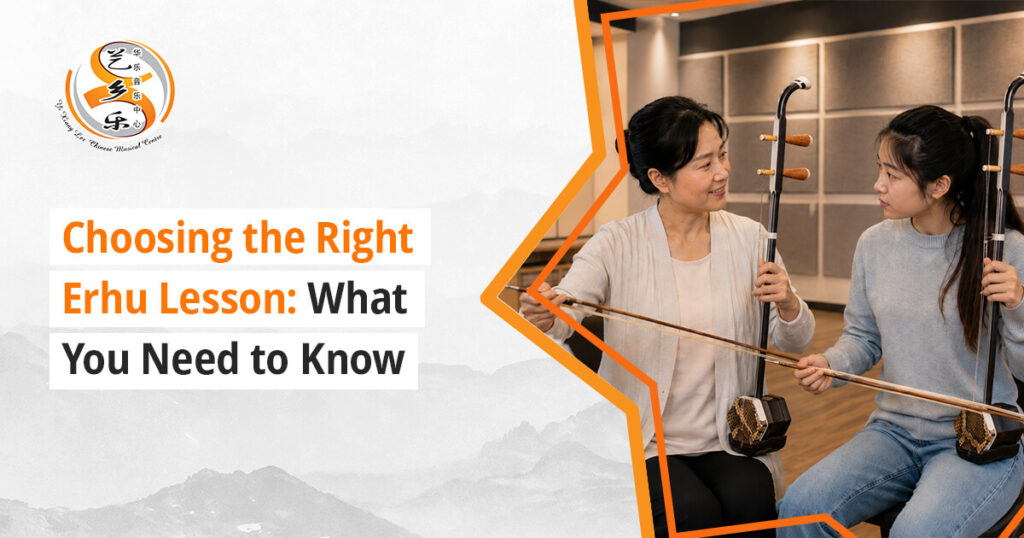
Learning the erhu can be a meaningful and rewarding experience, especially for students who are interested in Chinese traditional music. Known for its expressive sound and emotional tone, the erhu is a two-stringed Chinese bowed instrument that can produce melodies that are gentle, powerful, graceful and deeply moving.
However, choosing the right erhu lesson is not only about finding the nearest music centre or the cheapest lesson fee. A good erhu class should help students build proper techniques, understand the instrument, enjoy the learning process and improve step by step. Whether you are a complete beginner, a parent looking for an erhu class for your child, or an adult who wants to start learning Chinese musical instruments, the right learning environment can make a big difference.
Before you sign up for an erhu lesson, it is helpful to know what to look for in a class, what makes a good erhu teacher, and how to choose a lesson that matches your age, skill level and learning goals.
Understand Your Learning Goals Before Choosing an Erhu Lesson
Before choosing an erhu lesson, the first thing to consider is your learning goal. Different students learn the Chinese erhu instrument for different reasons, and your goal can affect the type of class that suits you best.
Some students want to learn erhu as a hobby. They may enjoy Chinese traditional music and want to play simple songs during their free time. For these students, a beginner-friendly erhu class with a relaxed learning pace may be more suitable.
Some parents may want their children to learn erhu to develop music appreciation, discipline, patience and cultural understanding. In this case, the class should provide proper guidance, structured lessons and a supportive environment for young learners.
Other students may be more serious about music performance. They may want to join concerts, school performances, music exams, competitions or Chinese orchestra activities. These students may need a more structured erhu course with stronger technical training, performance preparation and long-term learning planning.
Before enrolling, ask yourself:
- Are you learning erhu for hobby, interest or performance?
- Are you a complete beginner or do you already have music background?
- Do you prefer individual attention or group learning?
- Are you learning for cultural appreciation, personal enjoyment or examination preparation?
- How much time can you practise at home
When your goal is clear, it becomes easier to choose an erhu class that matches your needs.
Factors to Consider When Choosing an Erhu Lesson
Choosing an erhu lesson or music class is different from choosing a general activity class. The erhu is a Chinese musical instrument that requires correct posture, bowing control, finger placement, listening skills and consistent practice. Because of this, the quality of the class and teacher matters.
Below are the important factors to consider before joining an erhu lesson.
1. Class Size and Student Attention
Class size can affect how much attention each student receives during the lesson. For beginners, especially children, smaller class sizes are often helpful because the teacher can observe each student’s posture, hand position, bowing movement and sound quality more closely. If a student develops the wrong habit in the early stage, it may become harder to correct later.
A smaller erhu class also allows the teacher to give more personalised feedback. For example, one student may need help with holding the bow, while another may need guidance on pitch accuracy or rhythm. When the class is too large, students may not receive enough individual corrections.
That does not mean group classes are not good. A well-managed group erhu class can also be motivating because students get to learn together, listen to each other and build confidence. The key is whether the teacher can still manage the class properly and guide students based on their progress.
For students who need stronger guidance, a small group erhu class or one-to-one erhu lesson may be more suitable.
2. Learning Environment
A good learning environment helps students feel comfortable and focused. This is especially important for music learning because students need to listen, practise and receive feedback during class.
The learning space should be clean, organised and suitable for music lessons. It should not be too noisy or distracting. Since erhu produces a soft and expressive sound, a proper environment allows students to hear their tone clearly and make better adjustments.
For children, the environment should feel friendly and encouraging. Young learners may feel nervous when learning a new instrument, especially in the first few lessons. A supportive setting helps them feel more confident and willing to try.
For adults, the environment should feel respectful and comfortable. Many adult beginners worry that they are “too late” to start learning music. A good music centre should make adult learners feel welcomed, not embarrassed.
3. Lesson Content and Teaching Materials
A well-structured erhu class should have clear lesson content. Students should not feel like every lesson is random or disconnected from the previous one.
For beginners, the lesson should usually cover basic areas such as:
- Introduction to the erhu
- Correct sitting posture
- How to hold the instrument
- Bow grip and bowing direction
- Open string practice
- Basic rhythm and counting
- Finger placement
- Pitch accuracy
- Simple songs and exercises
- Listening and tone control
As students improve, the lesson content may include more advanced techniques, expressive playing, music interpretation, scale practice, ensemble training and performance preparation.
Teaching materials are also important. Good erhu learning materials should match the student’s level. If the material is too difficult, students may feel stressed. If it is too easy, they may not improve much.
A good erhu teacher should be able to choose suitable songs and exercises based on the student’s age, skill level and learning speed. For example, children may benefit from simple melodies and step-by-step exercises, while adults may enjoy learning familiar songs to stay motivated.
4. Performance and Learning Opportunities
One important factor that many students overlook is whether the erhu class provides performance or learning opportunities outside regular lessons.
Performance opportunities can help students build confidence and apply what they have learned. Even a small student performance can motivate learners to practise more seriously and improve their stage confidence.
For children, performances can help develop discipline, courage and teamwork. For adult learners, it can be a meaningful milestone and a chance to enjoy music beyond the classroom.
Some useful learning opportunities may include:
- Student recitals
- Music centre performances
- Chinese orchestra participation
- School or community performances
- Music camps or workshops
- Group practice sessions
- Examination or grading preparation
- Cultural event performances
Of course, not every student wants to perform. Some prefer to learn privately as a hobby. That is perfectly fine. However, it is still good to choose a music centre that offers opportunities, so students have the option to participate when they are ready.
5. Erhu Teacher
The erhu teacher is one of the most important factors when choosing a class. When reviewing an erhu teacher, consider the following areas.
5.1 Teaching Experience and Musical Background
A teacher’s musical background can help you understand their level of training and experience. This may include formal music education, performance experience, Chinese orchestra involvement, teaching history or experience working with different age groups.
However, a good performer is not automatically a good teacher. Teaching requires a different skill set. The teacher must be able to break down difficult techniques into simple steps so that students can understand and practise correctly.
For beginners, this is very important because erhu can be challenging at the start. Students need proper guidance in bowing, pitch control and posture. Without the right foundation, they may develop bad habits that affect their future progress.
5.2 Teaching Method and Approach
Every teacher has a different teaching style. Some are very strict and technical, while others are more relaxed and encouraging. The best approach depends on the student’s personality, age and learning goal.
For children, the teaching method should be structured but not too stressful. Young learners need clear instructions, repetition and encouragement. They may also need activities that keep them engaged.
For adults, the teacher should explain concepts clearly and respect the learner’s pace. Adult students often ask more questions and may want to understand the reason behind each technique.
A good erhu teacher should be able to teach step by step. Instead of rushing into songs too quickly, the teacher should help students build a strong foundation first. This includes proper posture, bowing control, left-hand finger placement, rhythm and listening skills. The right teaching method helps students improve steadily and enjoy the process.
5.3 Patience and Communication Skills
Patience is very important in erhu teaching. The erhu may sound beautiful when played well, but beginners may struggle with pitch, bowing and tone at the beginning. This is normal.
A patient teacher can help students feel less pressured. Instead of only pointing out mistakes, the teacher should explain how to improve and give students time to practise.
Good communication also matters. A teacher should be able to explain technical points in a way that students can understand. For example, instead of simply saying “your bowing is wrong,” a good teacher may explain how to relax the wrist, control bow pressure, or keep the bow movement steady.
For children, communication with parents is also useful. Parents may want to know how their child is progressing, what to practise at home and whether the child is ready for the next level.
For adult learners, clear communication helps reduce frustration. Many adults may feel nervous because they are starting from zero. A supportive teacher can make the learning experience more enjoyable.
5.4 Student Progress and Achievements
Another way to evaluate an erhu class is to look at student progress. This does not always mean winning competitions or passing exams. Progress can also mean better posture, improved tone, stronger rhythm, more confidence and the ability to play songs independently.
If a music centre has students who regularly participate in music performances, exams or ensemble activities, it may show that the class provides good training and learning support.
However, achievements should be viewed based on the student’s goal. A hobby learner does not need to follow the same path as a performance-focused student. What matters is whether the teacher can help each student improve according to their own direction.
6. Choose a Class That Matches Your Age and Skill Level
Different age groups learn differently. A suitable erhu class should match the student’s age, learning speed, attention span and musical background.
6.1 Erhu Classes for Children
Erhu classes for children should focus on building interest, discipline and a strong foundation. Children may need more guidance with posture, hand position, bowing movement and rhythm.
A good children’s erhu class should be patient, structured and encouraging. The teacher should know how to keep children engaged while still teaching proper technique.
Besides, parents should also understand that progress may take time. In the beginning, children may not play full songs immediately. They first need to learn how to produce a stable sound and control the instrument properly.
If the child enjoys Chinese traditional music instruments or is interested in joining a Chinese orchestra in school, learning erhu can be a good foundation.
6.2 Erhu Classes for Adults
Many adults wonder whether it is too late to learn erhu. The answer is no. Adults can learn erhu as long as they are patient and willing to practise consistently.
Adult learners often have different goals. Some want to learn for personal interest, some want to reconnect with Chinese culture, and some simply enjoy the sound of the erhu. Others may have learned music before and want to try a Chinese traditional music instrument.
A good adult erhu class should provide clear explanations, flexible pacing and practical practice guidance. Adults may prefer to understand why a technique is important, not just follow instructions blindly.
6.3 Beginner-Friendly Classes
A beginner-friendly erhu class is important for students with no music background. Since the erhu does not have frets like a guitar or fixed keys like a piano, beginners need to train their listening and finger placement carefully.
A good beginner erhu lesson should not rush students into difficult songs. Instead, it should help them understand the basics properly.
Students should also be reminded that the first stage may feel challenging. It takes time to produce a clean and stable sound. With the right teacher and regular practice, beginners can gradually improve and enjoy the instrument more.
Conclusion
Choosing the right erhu music lesson is an important step in your learning journey. A good lesson or class should match your goals, age, skill level and learning style. It should also provide proper guidance, a comfortable learning environment, suitable teaching materials and an experienced erhu teacher who can help you improve step by step.
Before enrolling, take time to understand the class structure, teacher background, lesson content and learning opportunities. The best erhu class is not always the most expensive or the nearest one. It is the class that helps you learn properly, stay motivated and grow with confidence.

Start Your Erhu Learning Journey
Interested in learning erhu? Join Yi Xiang Ler Chinese Musical Centre and discover a structured, beginner-friendly erhu class designed to help students build proper techniques, confidence, and appreciation for Chinese traditional music. Whether you are a child, adult, or beginner, we provide guidance to help you start your erhu journey.
Contact us today to learn more about our erhu lesson.